THE GARAGE
There is a garage in Corpus Christi. It has camera gear in it, film in the fridge door, and things that belonged to people who are not here anymore. I don't do my thinking in there, though — the garage is for gear and for laundry. The thinking happens somewhere else: on the toilet, on the drive to and from work, at my desk. But the garage is where all of it is kept, so that is where this starts.
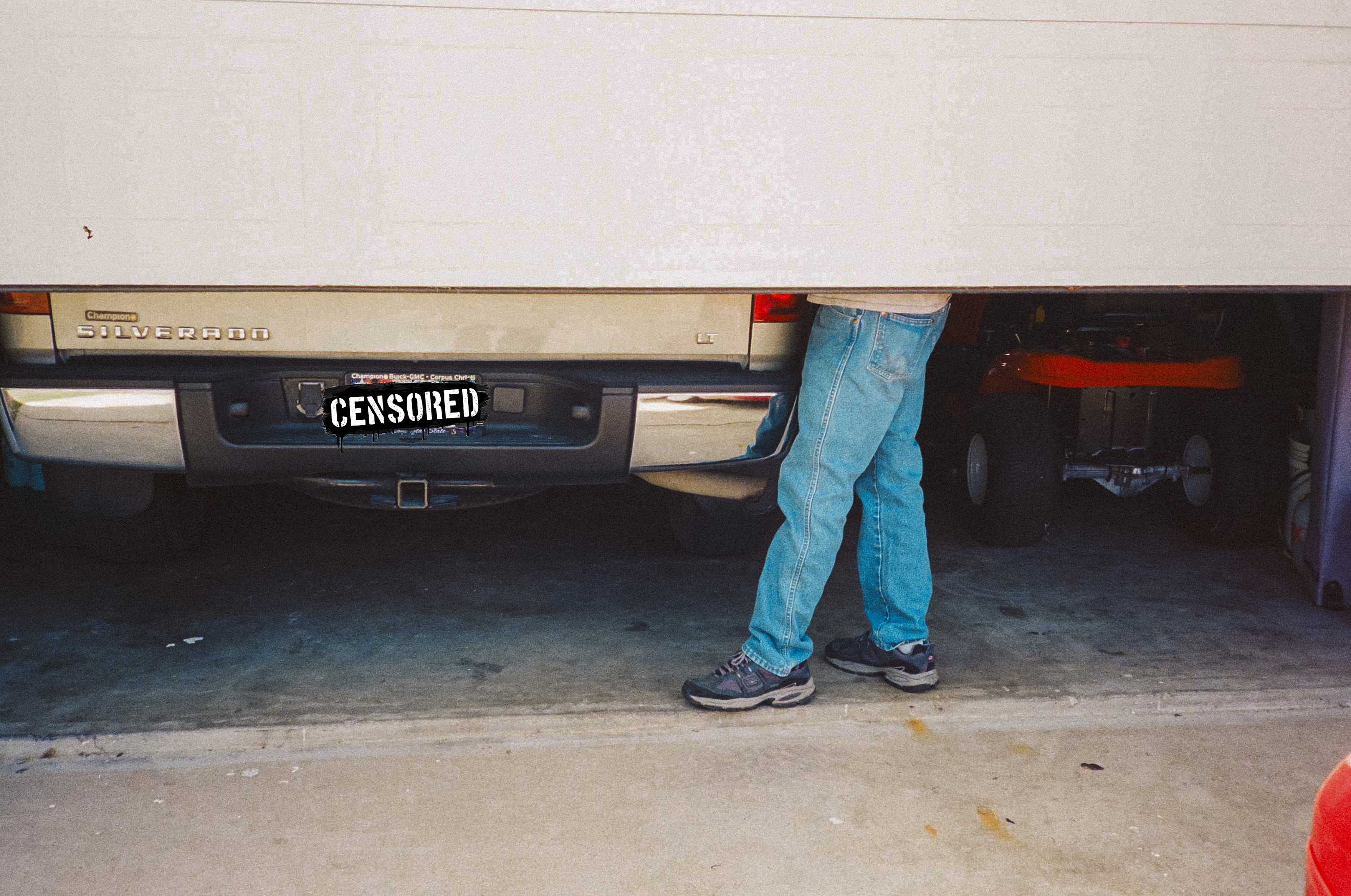
I want to tell you how I ended up a man who photographs loud rooms for no money and calls it the most important thing he does. It starts, like most of my story, with my dad.
BOBBY
Let me be clear about who Bobby was. Bobby was my stepdad. He came into my life when I was around four and stayed until I was forty-one, when he passed in April of 2024. My biological father, Joe, died in August of 1984, before I was even two. So when I say Bobby is the reason any of this exists, understand that he chose this. He gave everything of himself to this family.
He drove a 1970 Ford F100 with some shit little speakers he'd rigged up himself, basically tweeters, and that truck is where he handed me heavy music the way other dads hand down tools. Judas Priest. Motley Crue. AC/DC. I did not discover this music. I inherited it. There is a difference, and the difference is him.
One day we're driving home from running an errand. Two-forty AC, which if you don't know is two windows down at forty miles an hour, and he puts on Motley. Dr. Feelgood. He's jamming, and he's explaining the song to me, breaking it down like it matters, because it does. I was twelve. Then we pull into the driveway and he turns the volume all the way down so my mom won't hear it blasting. "Don't tell mom," he says, staring straight through my soul. "I won't! I promise!" So if you're reading this, mom: sorry. That was our secret.
There were nights he'd call me back to his room after work just to play me a song or a band and tell me a story from when he was a rebellious kid himself. One of the first concerts he ever went to was Sammy Hagar, out on Padre Island by Port Isabel, with my mom, back in the late eighties.
He died in April of 2024. I am not going to dress that up for you. There is music I still cannot play all the way through.
But here is the thing I keep learning. When I am pressed against a barricade and the first chord hits the room like weather, he is there. Not in a mystical way. In a practical way. He is in the fact that I know this music in my body, that my ears were trained in his truck and his living room, that I flinch at nothing. Every show I shoot, I am using something he gave me. The inheritance keeps paying out.
Every show, I wish I could have gone with my Pops. I am grateful my sister Tiffany got to take him to one. I know he had a blast.
LEARNING TO STAY
I did not come up through a photo school or a magazine. I came up through three years as the official photographer of the Texas Iron Rally, a biker rally in the Hill Country, which is a sentence that does more work than it looks like.
A rally is not a concert. There is no set list and no pit and no fifteen-minute window. There is just days of American subculture happening in every direction, and you learn fast that the only way to shoot it is to live inside it. Eat with people. Learn names. Be there so long you stop being a camera and start being furniture. Then, and only then, do people show you who they actually are.
That is where my style comes from. Embedded. Patient. I shoot moody and desaturated because that is how those nights actually felt, dust and diesel and firelight, not like a beer commercial. I learned to wait for the human detail instead of the spectacle. The spectacle is easy. The suburban mom in workout gear throwing up horns next to a man with a face tattoo, that is the photograph.
I carry that into every venue now. Some of it I shoot digital. A lot of it I shoot on film, old Canon, Chinon, and Pentax bodies, because film makes you slow down and choose, and because grain feels like memory to me in a way pixels never quite have.
ACCESS
I have never held a press credential. Everything I have gotten, I got by showing up enough times, being useful, being human, and not acting like I was owed anything.
I have seen Jinjer four times. At one of those shows I gave Tatiana Shmailyuk a pair of Buc-ee's socks, because if you know Texas you know that is a sincere gift, and she wore them on stage. Another night, in a parking lot, Chino Moreno from Deftones rode my orange fixie around like a kid while I stood there trying to act like this was normal.
I am not telling you this to name-drop. I am telling you because it is the entire thesis of Barrio Noise. The wall between the crowd and the stage is thinner than the industry wants you to believe. You do not need a laminate to be part of this. You need to keep showing up with your whole chest. The credential I am chasing this year is not permission to belong. I already belong. It is just a better place to stand.
SAUL
My friend Saul died of cancer. This was not long ago, and it sits right next to my dad's death in the part of my chest where I keep the reasons.
Before he got too sick, I shot a portrait session with him. Real portraits, careful ones. At the time it felt like a thing friends do. Now it is one of the most important things I have ever done with a camera, and it did not happen at any show, and nobody ever paid me a dollar for it.
That session rearranged how I understand this work. A photograph is not content. It is proof of presence. It says: he was here, the light fell on him exactly this way, and someone loved him enough to pay attention. That is what I am actually doing at every show, to every stranger in every crowd. Paying the kind of attention you can hand to somebody's family later.
Saul's portraits will have a permanent home on this site someday, when I am ready. Not yet.
WHAT THE GARAGE HOLDS
So that is the throughline, if you want it drawn straight. The two men who most shaped why I do this are both gone, and the camera is how I refuse to let go of what they left. My dad gave me the music. Saul taught me what the pictures are for. The garage holds the gear and the mementos, and I hold the rest.
People ask why I would spend my own money chasing a press pass to a show in another country when nobody is making me do it. This is why. I have been in these rooms since I was seventeen, since I saved a Taco Bell paycheck to see A Perfect Circle because nobody would take me. Twenty five years later I am still buying my own ticket, still pressed against the rail, still waiting for the human detail.
The bands change. The rooms change. The attention is the constant. That is the whole thing.
Hay un garaje en Corpus Christi. Tiene equipo de cámara, rollos de película en la puerta del refrigerador, y cosas que pertenecieron a gente que ya no está. Pero ahí no hago mi pensar — el garaje es para el equipo y para la lavandería. El pensar pasa en otro lado: en el escusado, en el camino de ida y vuelta al trabajo, en mi escritorio. Pero el garaje es donde se guarda todo, así que ahí empieza esto.
Quiero contarte cómo terminé siendo un hombre que fotografía salas ruidosas sin cobrar y lo llama lo más importante que hace. Empieza, como casi toda mi historia, con mi papá.
BOBBY
Déjame ser claro sobre quién era Bobby. Bobby era mi padrastro. Llegó a mi vida cuando yo tenía como cuatro años y se quedó hasta que yo tenía cuarenta y uno, cuando falleció en abril de 2024. Mi padre biológico, Joe, murió en agosto de 1984, antes de que yo cumpliera los dos. Así que cuando digo que Bobby es la razón de que todo esto exista, entiende que él lo eligió. Le dio todo de sí a esta familia.
Manejaba una Ford F100 del 70 con unas bocinitas de mierda que él mismo había conectado, prácticamente tweeters, y esa troca es donde me pasó la música pesada como otros papás heredan herramientas. Judas Priest. Motley Crue. AC/DC. Yo no descubrí esta música. La heredé. Hay una diferencia, y la diferencia es él.
Un día vamos de regreso a casa después de un mandado. Aire dos-cuarenta, que si no sabes es dos ventanas abajo a cuarenta millas por hora, y pone Motley. Dr. Feelgood. Va cantando, y me va explicando la canción, desmenuzándola como si importara, porque importa. Yo tenía doce. Luego entramos a la cochera y le baja todo el volumen para que mi mamá no lo oiga a todo lo que da. «No le digas a tu mamá», me dice, mirándome hasta el alma. «¡No le digo! ¡Lo prometo!» Así que si estás leyendo esto, mamá: perdón. Ese era nuestro secreto.
Había noches en que me llamaba a su cuarto después del trabajo nada más para ponerme una rola o una banda y contarme una historia de cuando él era un chamaco rebelde. Uno de los primeros conciertos a los que fue en su vida fue Sammy Hagar, en Padre Island por Port Isabel, con mi mamá, allá a finales de los ochenta.
Murió en abril de 2024. No te lo voy a adornar. Hay música que todavía no puedo escuchar completa.
Pero aquí está lo que sigo aprendiendo. Cuando estoy pegado a una valla y el primer acorde golpea la sala como el clima, él está ahí. No de manera mística. De manera práctica. Está en el hecho de que conozco esta música con el cuerpo, de que mis oídos se entrenaron en su troca y en su sala, de que nada me hace parpadear. En cada show que fotografío estoy usando algo que él me dio. La herencia sigue pagando.
En cada show, quisiera haber podido ir con mi Pops. Estoy agradecido de que mi hermana Tiffany lo haya podido llevar a uno. Sé que la pasó increíble.
APRENDER A QUEDARSE
Yo no me formé en una escuela de foto ni en una revista. Me formé en tres años como fotógrafo oficial del Texas Iron Rally, un rally de bikers en el Hill Country, que es una frase que trabaja más de lo que aparenta.
Un rally no es un concierto. No hay setlist, no hay foso, no hay ventana de quince minutos. Hay días enteros de subcultura americana sucediendo en todas direcciones, y aprendes rápido que la única manera de fotografiarla es vivir adentro de ella. Comer con la gente. Aprenderte los nombres. Estar ahí tanto tiempo que dejas de ser una cámara y te vuelves un mueble. Entonces, y solo entonces, la gente te muestra quién es de verdad.
De ahí viene mi estilo. Integrado. Paciente. Fotografío oscuro y desaturado porque así se sentían de verdad esas noches, polvo y diesel y luz de fogata, no como comercial de cerveza. Aprendí a esperar el detalle humano en lugar del espectáculo. El espectáculo es fácil. La mamá suburbana en ropa de gimnasio levantando los cuernos junto a un hombre con la cara tatuada, esa es la fotografía.
Eso lo cargo ahora a cada recinto. Una parte la hago en digital. Mucha la hago en película, cuerpos viejos de Canon, Chinon y Pentax, porque la película te obliga a ir despacio y escoger, y porque el grano se siente como memoria de una manera que los píxeles nunca han logrado.
ACCESO
Nunca he tenido credencial de prensa. Todo lo que he conseguido lo conseguí apareciendo suficientes veces, siendo útil, siendo humano, y sin actuar como si me debieran algo.
He visto a Jinjer cuatro veces. En uno de esos shows le regalé a Tatiana Shmailyuk un par de calcetines de Buc-ee's, porque si conoces Texas sabes que ese es un regalo sincero, y los usó en el escenario. Otra noche, en un estacionamiento, Chino Moreno de Deftones anduvo en mi fixie naranja como niño mientras yo trataba de fingir que eso era normal.
No te cuento esto por presumir. Te lo cuento porque es la tesis entera de Barrio Noise. La pared entre el público y el escenario es más delgada de lo que la industria quiere que creas. No necesitas un gafete para ser parte de esto. Necesitas seguir apareciendo con todo el pecho. La credencial que persigo este año no es permiso para pertenecer. Yo ya pertenezco. Es solo un mejor lugar donde pararse.
SAÚL
Mi amigo Saúl murió de cáncer. No hace mucho, y su muerte vive junto a la de mi papá en la parte del pecho donde guardo las razones.
Antes de que se pusiera muy enfermo, hice una sesión de retratos con él. Retratos de verdad, cuidadosos. En ese momento se sintió como algo que hacen los amigos. Ahora es una de las cosas más importantes que he hecho con una cámara, y no pasó en ningún concierto, y nadie me pagó un dólar por ella.
Esa sesión reacomodó cómo entiendo este trabajo. Una fotografía no es contenido. Es prueba de presencia. Dice: él estuvo aquí, la luz le cayó exactamente así, y alguien lo quiso lo suficiente como para prestarle atención. Eso es lo que realmente estoy haciendo en cada show, con cada desconocido en cada multitud. Prestando el tipo de atención que después se le puede entregar a la familia de alguien.
Los retratos de Saúl tendrán un hogar permanente en este sitio algún día, cuando yo esté listo. Todavía no.
LO QUE GUARDA EL GARAJE
Así que esa es la línea, si la quieres derecha. Los dos hombres que más formaron el porqué de esto ya no están, y la cámara es mi manera de negarme a soltar lo que dejaron. Mi papá me dio la música. Saúl me enseñó para qué son las fotos. El garaje guarda el equipo y los recuerdos, y yo guardo el resto.
La gente pregunta por qué gastaría mi propio dinero persiguiendo un pase de prensa para un show en otro país cuando nadie me obliga. Por esto. Llevo en estas salas desde los diecisiete, desde que junté un sueldo de Taco Bell para ver a A Perfect Circle porque nadie me quiso llevar. Veinticinco años después sigo comprando mi boleto, sigo pegado a la valla, sigo esperando el detalle humano.
Las bandas cambian. Las salas cambian. La atención es la constante. De eso se trata todo.